

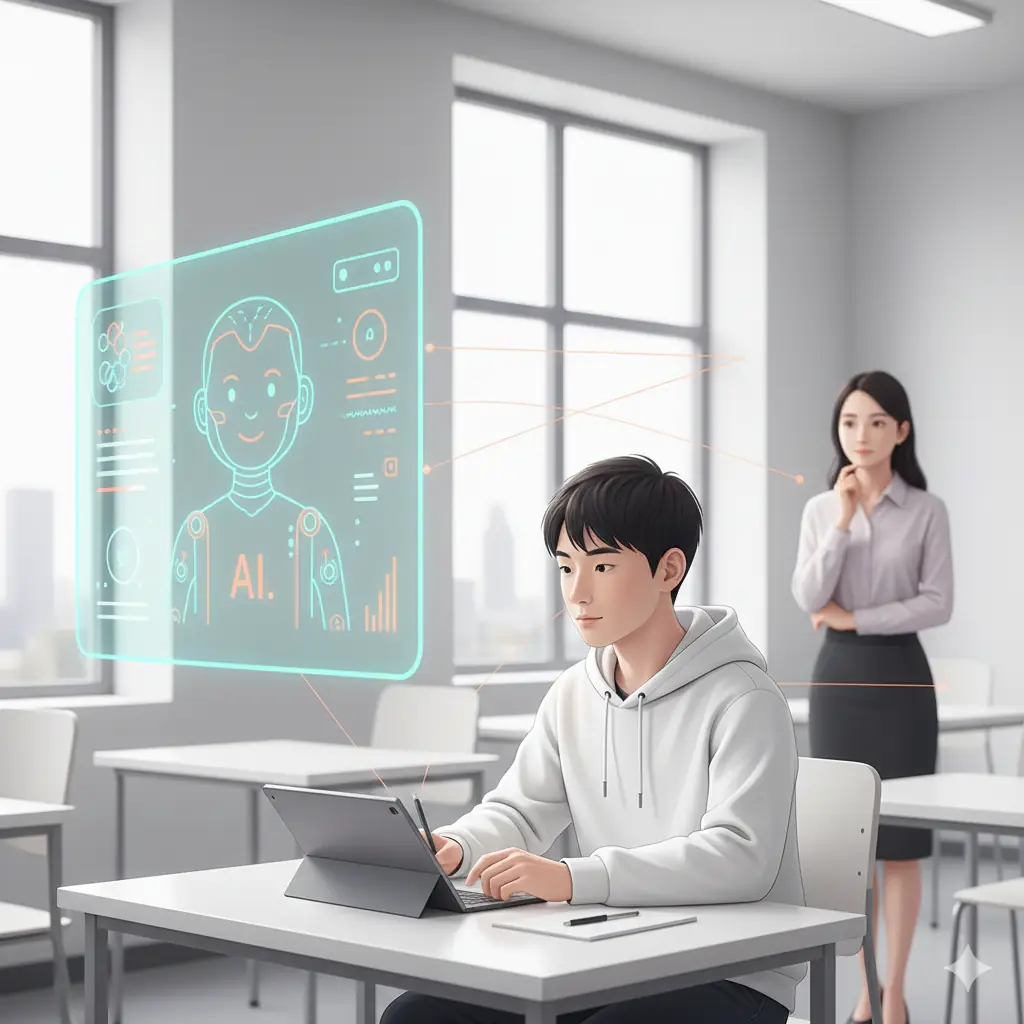
💡 A New Era of Personalized Attention
Imagine a classroom where every student has a dedicated, infinitely patient tutor available 24/7. That’s the promise of AI tutors, and it’s rapidly moving from science fiction into educational reality.
For decades, the ideal in education has been one-on-one instruction, but the reality is a busy teacher juggling thirty students. AI is starting to fill that gap, offering scalable personalization.
These intelligent systems are designed to understand an individual student’s pace, learning style, and specific knowledge gaps, adapting their instruction accordingly.
The goal isn’t to replace the human element of teaching, but rather to ensure that every learner gets the tailored attention they need to master complex concepts.
🧠 How AI Tutors Actually Work
AI tutors operate by leveraging machine learning and large language models (LLMs) to analyze student performance data in real time. They are constantly reading the digital room, so to speak.
When a student answers a question, the AI doesn’t just mark it right or wrong. It analyzes the *type* of mistake made, identifying the underlying misconception, much like an experienced human tutor would.
If a student struggles with algebraic functions, the AI might pause the current lesson and generate supplementary problems focused specifically on prerequisite skills, like simplifying exponents, before allowing them to proceed.
This adaptive feedback loop is what makes them so effective. They provide immediate, targeted interventions that prevent small confusion from becoming major knowledge deficits.
The Power of Instant and Varied Feedback
One of the most valuable contributions of AI tutors is the speed and variety of feedback they provide. Traditional grading can take days; AI feedback is instantaneous.
This rapid response is crucial for learning, as it allows students to correct misunderstandings immediately while the concept is fresh in their minds. It’s learning in the moment of need.
Furthermore, AI can offer multiple modalities of explanation. If a student doesn’t grasp a concept from a text explanation, the AI can generate a diagram, a simplified analogy, or even a short video clip.
For example, if a student is writing a difficult coding function, the AI can review the code and instantly suggest optimisations, explain why the current logic failed, and provide a corrected example.
👩🏫 Redefining the Teacher’s Role
With AI handling the repetitive tasks of grading, drilling, and basic remediation, the role of the human educator is fundamentally elevated. Teachers are freed from being mere content delivery systems.
Instead, the teacher becomes a facilitator, a coach, and a mentor. Their focus shifts to higher-order activities that AI cannot replicate: fostering creativity, critical thinking, emotional development, and collaborative projects.
The human teacher excels at inspiring curiosity, managing classroom dynamics, and providing empathetic support—skills that require true human judgment and connection.
AI tutors also provide teachers with unprecedented diagnostic insights. They deliver summarized data on class weaknesses, allowing the teacher to dedicate precious in-class time to targeted group discussions and complex problem-solving.
🤝 Integrating AI: A Collaborative Roadmap
Bringing AI tutors into the classroom is a process of integration, not replacement. For this transition to be successful, a structured approach is essential for both students and educators.
- Pilot and Validate: Begin with specific subjects (like math or foundational sciences) to test the AI’s effectiveness and reliability with a small group of learners.
- Educator Training: Provide extensive professional development on how to interpret AI-generated student data and how to use that data to inform their classroom pedagogy.
- Clear Boundaries: Establish clear policies on when the AI should be used for drilling and when the human teacher must step in for deeper concept exploration and critical discussion.
- Ethical Review: Continuously monitor data privacy and algorithmic bias to ensure the AI tutor provides equitable and fair educational opportunities for all students.
- Iterate and Adapt: Treat the AI tutor as a constantly evolving tool, gathering feedback from teachers and students to refine its functionality and integration methods.
🔮 The Ethical Horizon and The Human Touch
As powerful as AI tutors are, their deployment raises important ethical questions, primarily around data security and the potential for increased screen time. We must deploy them thoughtfully.
The goal is to use AI to enhance learning, not to diminish the crucial social and emotional development that happens in a human-led classroom. Social interaction and peer learning remain irreplaceable.
For instance, an AI might teach the principles of teamwork, but only a collaborative project among students can teach them the empathy and compromise needed to truly work together effectively.
By keeping the human teacher at the center of the educational strategy, and using AI tutors as powerful, personalized assistants, we can create a future classroom that is both highly effective and deeply humane.
