

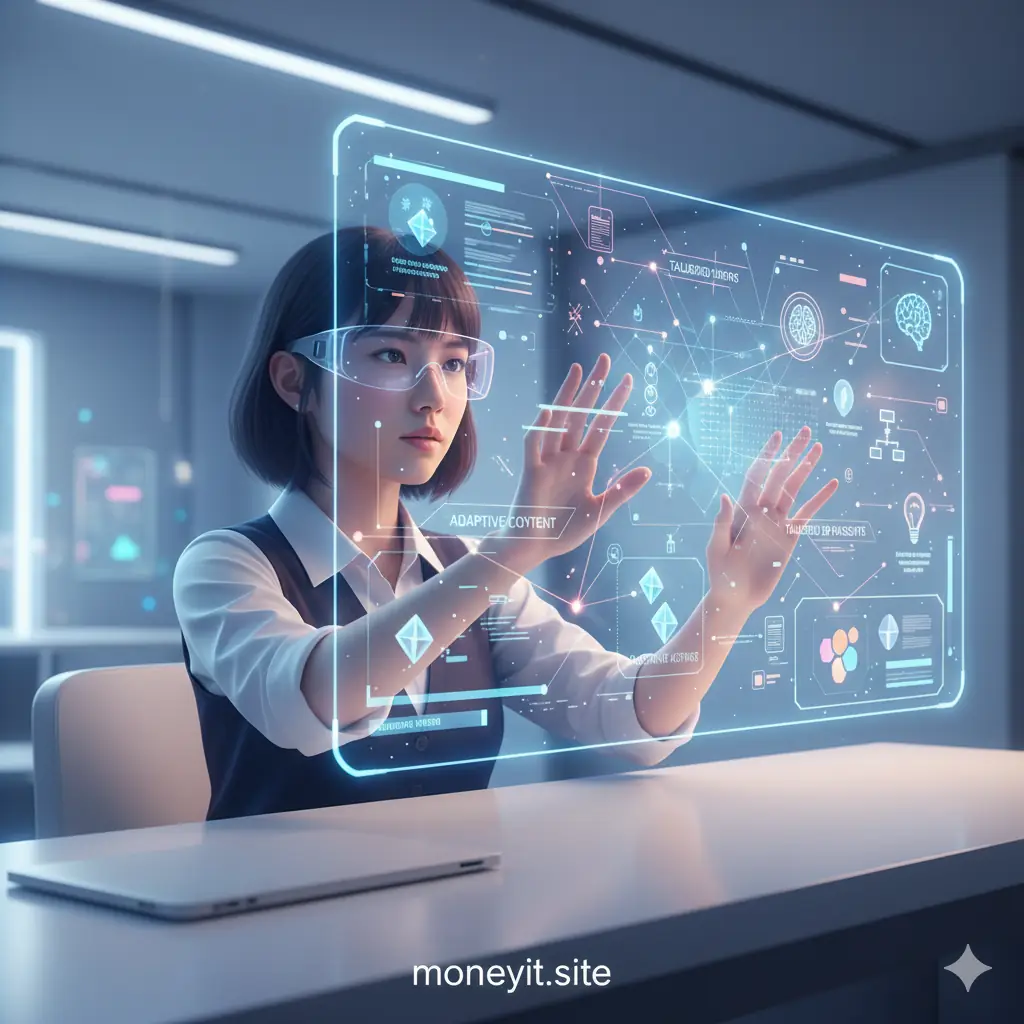
🌟 Education for One: The Promise of Personalization
For decades, education has largely followed a ‘one-size-fits-all’ model. Students progress through curriculum at roughly the same pace, regardless of their individual learning styles, prior knowledge, or unique challenges.
However, we’re now in an exciting era where technology is making truly personalized education not just a dream, but a widespread reality. Imagine a learning experience crafted just for you.
This isn’t about isolating students; it’s about using smart tools to understand each learner deeply and then adapt the educational journey to best suit their needs.
Technology acts as a powerful enabler, allowing educators to move beyond average instruction and create truly student-centered learning environments.
💡 Adaptive Learning Platforms: Your Digital Tutor
One of the most impactful technological advancements in personalized education comes in the form of adaptive learning platforms. These systems are designed to adjust content and pace based on a student’s real-time performance.
Think of it as having a digital tutor that always knows what you know, what you don’t know, and how you learn best. If you’re struggling with a concept, the platform provides extra explanations and practice.
Conversely, if you quickly grasp a topic, it will challenge you with more advanced material, preventing boredom and keeping you engaged. This dynamic adjustment is key to sustained learning.
For example, a student using an adaptive math program might receive different types of problems, supplementary videos, or even gamified challenges based on their responses, ensuring targeted support or acceleration.
Data Analytics: The Engine of Personalization
Behind every effective personalized learning experience is a robust engine of data analytics. Technology collects rich data on how students interact with content, perform on assessments, and progress over time.
This data isn’t just about grades; it reveals patterns in learning: which concepts are challenging, which resources are most effective, and where a student might need additional intervention.
Educators use these insights to refine their teaching strategies, identify at-risk students early, and provide targeted support—moving from reactive teaching to proactive intervention.
It’s about having a clear picture of each student’s journey, allowing for timely and precise adjustments to their learning path.
⚙️ AI and Machine Learning: Smarter Learning Paths
Artificial Intelligence (AI) and Machine Learning (ML) are taking personalization to the next level. These technologies are capable of much more than just adapting content; they can predict learning needs and optimize entire educational pathways.
AI can analyze a student’s past performance across various subjects and recommend future courses or career paths that align with their strengths and interests. It’s like having a highly informed academic advisor.
Intelligent tutoring systems, powered by AI, can offer conversational feedback, guide students through complex problems, and even simulate real-world scenarios for practice.
This advanced level of customization ensures that learning is not just adapted but actively optimized for individual success.
| Technology | How It Personalizes | Example Benefit |
|---|---|---|
| Adaptive Platforms | Adjusts content difficulty & pace | Targets specific learning gaps |
| Data Analytics | Tracks performance & engagement patterns | Early identification of struggling students |
| AI/ML Tutors | Provides intelligent, conversational feedback | Simulates one-on-one expert guidance |
| VR/AR | Creates immersive, experiential learning | Allows safe practice in virtual environments |
🌐 Accessibility and Inclusivity: Reaching Every Learner
Personalized education also means making learning accessible to every student, regardless of their physical abilities, learning differences, or geographic location.
Technology provides tools like text-to-speech, speech-to-text, closed captioning, and customizable interfaces, breaking down barriers for students with disabilities. This creates truly inclusive learning environments.
For students in remote areas, online platforms deliver high-quality educational resources that would otherwise be unavailable, connecting them to world-class instruction and diverse perspectives.
This emphasis on accessibility ensures that personalized learning isn’t just for some, but for all, fostering true equity in education.
🤝 The Role of the Educator: Guide and Facilitator
While technology automates many aspects of personalization, it doesn’t diminish the role of the educator. Instead, it transforms it, allowing teachers to focus on deeper, more meaningful interactions.
Teachers become facilitators, mentors, and guides. They interpret the data provided by technology to understand student needs, design targeted interventions, and foster critical thinking and creativity.
With technology handling content delivery and basic assessment, educators can dedicate more time to one-on-one coaching, facilitating collaborative projects, and addressing social-emotional learning needs.
This partnership between human expertise and technological capability creates the most powerful form of personalized education.
✨ The Future: Empowered Learners, Tailored Journeys
The journey towards fully personalized education is ongoing, but technology is accelerating its pace. As these tools become more sophisticated and widely available, the impact will be profound.
Students will be empowered to take greater ownership of their learning, pursuing their interests with tailored support and resources, leading to deeper understanding and greater achievement.
Ultimately, technology is enabling an educational future where every student’s unique potential can be fully realized, creating a more engaging, effective, and equitable learning landscape for all.
