

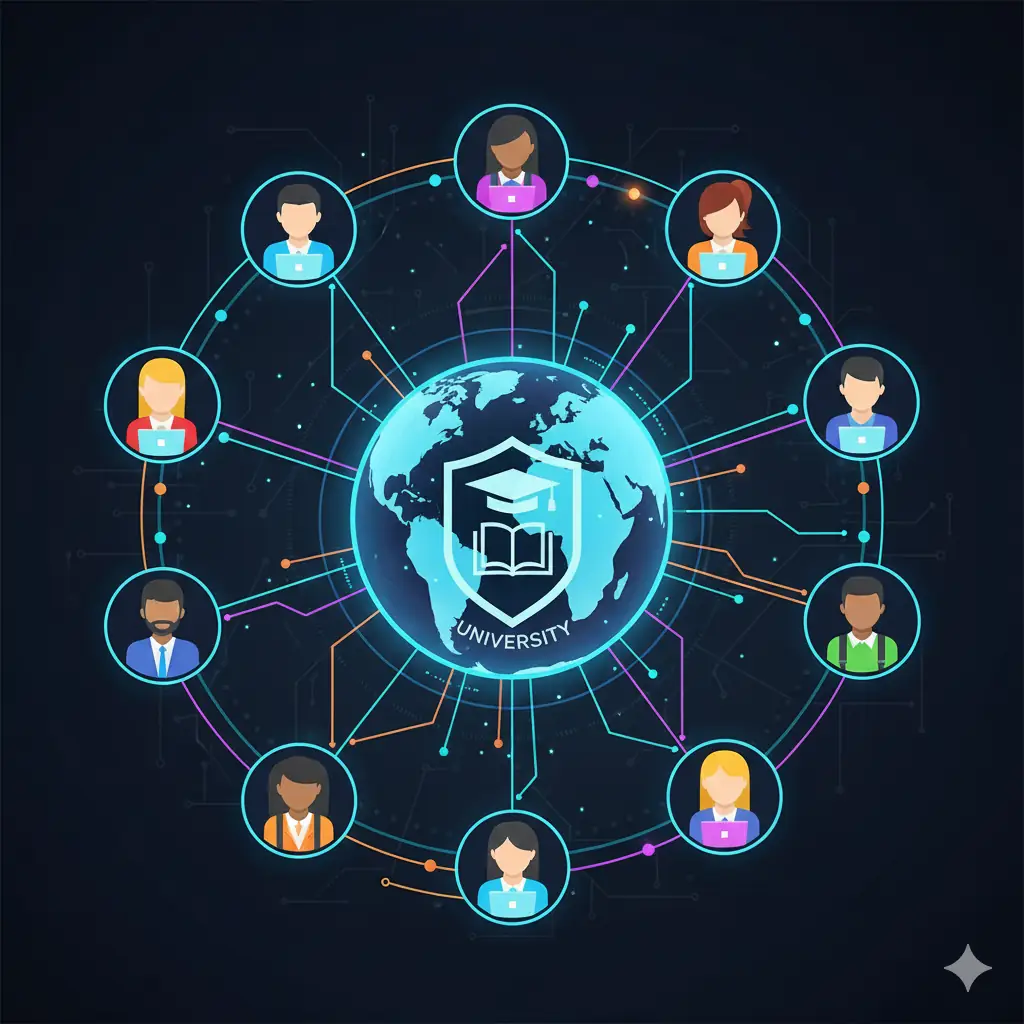
🌍 Breaking Down Walls: A New Educational Landscape
For centuries, the classroom was defined by physical proximity—students and teachers sharing the same room. Today, technology has fundamentally shattered those walls, giving rise to the Global Online Classroom.
This isn’t just about remote learning; it’s about connecting learners from diverse corners of the world into a single, shared educational experience, regardless of time zones, geography, or economic standing.
The impact of this shift is profound, transforming education into a far more accessible, culturally rich, and ultimately, a more equitable endeavor than ever before.
Let’s explore the key ways these borderless digital spaces are shaping the future of teaching and learning.
🚪 Universal Access and Democratization of Knowledge
The most immediate and critical impact of global online classrooms is the democratization of education. High-quality instruction is no longer confined to affluent regions or prestigious physical campuses.
Students in rural areas or developing countries can now access university lectures, specialized professional development, and even K-12 curriculum that were previously unattainable.
Massive Open Online Courses (MOOCs) are a prime example, offering highly technical or specialized subjects, taught by world-renowned experts, to anyone with an internet connection for free or at a low cost.
This universal access acts as a powerful equalizer, ensuring that educational opportunity is determined by motivation and effort, not simply by location or wealth.
Overcoming Geographic and Time Barriers
Global online classrooms solve the dual challenges of location and time. Students can engage in learning that accommodates their personal schedules, thanks to a mix of synchronous and asynchronous resources.
The ability to access recorded lectures (asynchronous) and review materials multiple times is vital for students juggling work or family commitments, or those managing significant time differences.
For example, a live synchronous session can be recorded and instantly made available for a peer on the other side of the globe, ensuring equitable access to the core content.
This flexibility ensures that education adapts to the learner’s life, making lifelong learning truly achievable.
🗣️ Fostering Cross-Cultural Collaboration and Understanding
Perhaps the richest impact of the global online classroom is the opportunity for authentic cross-cultural exchange. When students from five different continents collaborate on a single project, the learning deepens exponentially.
Students learn to communicate effectively across linguistic and cultural norms, a skill absolutely essential for the globalized job market of the 21st century.
Imagine a business ethics class where students from Germany, Brazil, and China debate the same case study, each bringing a unique national perspective on corporate responsibility.
This exposure doesn’t just teach course material; it cultivates empathy, broadens worldviews, and prepares students to become truly effective global citizens.
⭐ Key Insight: The global online classroom transforms abstract concepts of diversity into tangible, daily learning experiences.
🛠️ The Role of Integrated Technology
The success of these global classrooms relies entirely on integrated educational technology (EdTech) that supports complex, large-scale virtual interactions.
Learning Management Systems (LMS) act as the central hub, providing streamlined access to assignments, grading, and resources, regardless of the learner’s local network.
Integrated translation services, digital whiteboards, and video conferencing tools with stable bandwidth support all ensure that the diverse student body can interact with content and each other effectively.
Furthermore, cloud-based tools allow for real-time collaborative document creation, enabling groups scattered across continents to co-author papers or presentations seamlessly.
📈 The Future of Global Credentials and Careers
Global online classrooms are fundamentally reshaping professional development and career pathways. The shift proves that competency and skills matter more than the physical location of study.
As these models mature, we are seeing the rise of globally recognized digital credentials and micro-certifications that hold verified value across international markets.
Employers increasingly value candidates who possess the self-discipline, digital literacy, and cross-cultural communication skills honed in a successful global online learning environment.
The impact is clear: the global online classroom is directly fueling a globally skilled and highly adaptable workforce.
🔭 A More Equitable Educational Future
While challenges like the digital divide persist, the trajectory of global online classrooms is overwhelmingly positive. They provide powerful tools to overcome systemic educational inequalities.
By offering flexibility, personalized support, and worldwide connectivity, these virtual spaces are making higher education a realistic option for millions previously marginalized.
The global online classroom is more than just a delivery method; it’s a movement towards a collaborative and interconnected future where knowledge truly empowers everyone, everywhere.
