

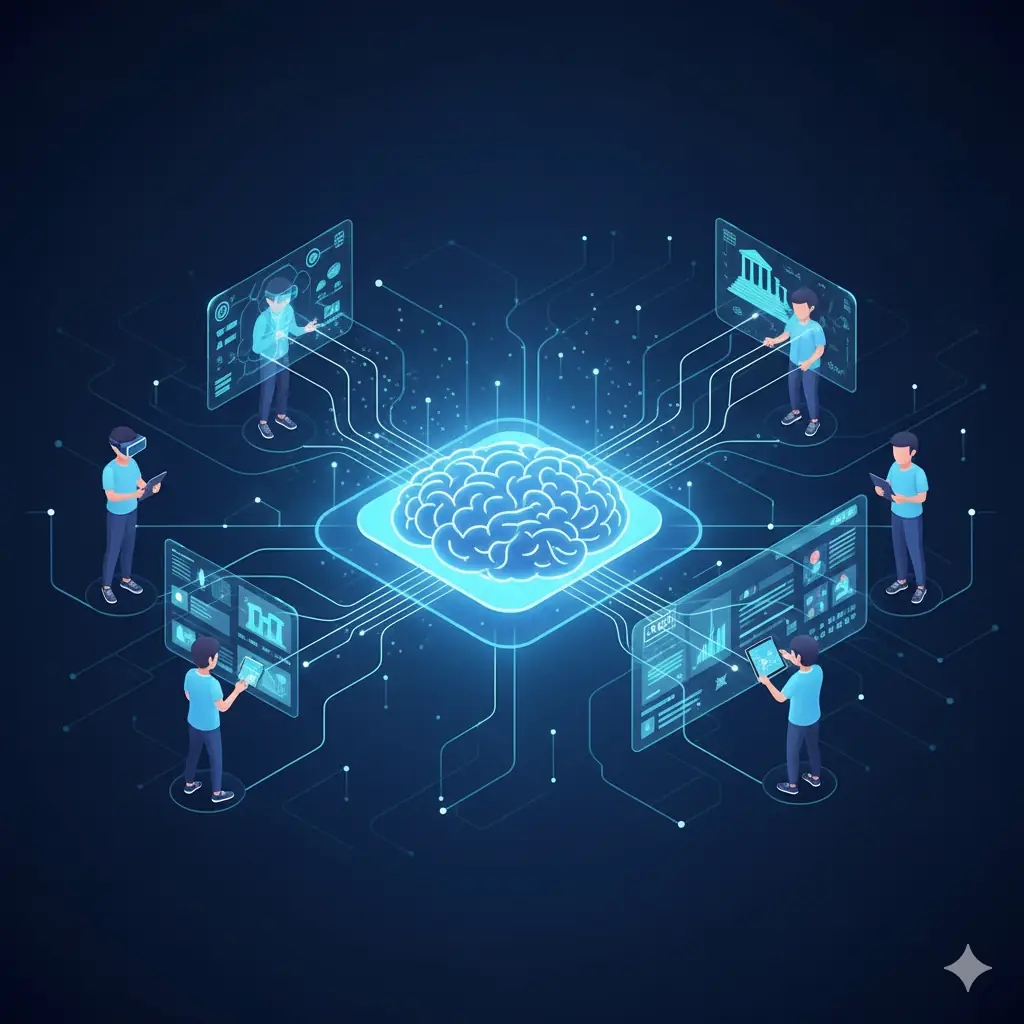
🚀 Beyond Buffering: The Promise of 5G Connectivity
For many years, the effectiveness of online learning has been constrained by bandwidth. Slow download speeds, video buffering, and unreliable connections have been persistent frustrations for both students and educators.
The rollout of 5G technology—the fifth generation of cellular networks—is poised to eliminate these bottlenecks. 5G promises revolutionary speed, massive capacity, and near-instantaneous responsiveness, or low latency.
This isn’t just a slight upgrade; it’s a complete reimagining of what is technically possible in a virtual classroom. It moves the online learning experience from functional to truly seamless and immersive.
Let’s delve into the specific ways 5G will unlock the next generation of online education, making learning faster, richer, and more equitable.
⚡ Zero Lag: Enabling Real-Time Synchronous Learning
One of 5G’s most critical features is its ultra-low latency. Latency is the delay between sending information (like clicking a button) and receiving a response. High latency causes lag in video calls and digital interactions.
By drastically reducing this delay, 5G will make live synchronous learning experiences virtually indistinguishable from being in the same physical room. Video conferences will be smoother, and digital whiteboards will update instantly.
This allows for genuinely real-time collaboration. Students from different continents can simultaneously co-edit a complex design or participate in a fluid, rapid-fire Q&A session without frustrating delays.
The elimination of lag will normalize global collaboration, making peer-to-peer learning instantaneous and highly effective.
Unlocking High-Fidelity Multimedia Content
The speed of 5G connectivity—significantly faster than 4G—means that high-definition content, which was previously impractical, becomes the new standard for online lessons.
Teachers can seamlessly stream 4K or 8K video lectures, share huge data sets, and use graphically intensive educational simulations without worrying about bandwidth issues or quality degradation.
This capability is particularly important for subjects like medicine, engineering, and art, where visual clarity and detail are essential components of the learning material.
The educational experience becomes visually richer, more detailed, and far more engaging.
🔮 The Immersive Classroom: VR and AR
Perhaps the most transformative impact of 5G will be in the realm of immersive technologies like Virtual Reality (VR) and Augmented Reality (AR). These require massive data throughput and minimal latency to function effectively.
VR training simulations—such as virtual anatomy labs or complex engineering assembly practices—can be streamed instantly over 5G networks. This makes high-cost, specialized training affordable and widely accessible.
For example, a student using an AR headset can walk around a city street and instantly see historical data or architectural blueprints overlaid onto the real buildings, creating a contextualized learning experience.
5G makes these sophisticated, high-data experiences mobile and untethered, moving them out of specialized computer labs and into any classroom or student’s home.
⭐ Key Insight: 5G provides the network infrastructure necessary to move education from passive viewing of 2D content to active, collaborative engagement in 3D virtual worlds.
🌐 Bridging the Digital Divide and Enhancing Equity
For many communities, especially in rural or underserved areas, access to high-speed fixed broadband is prohibitively expensive or simply unavailable. 5G offers a potent solution to this digital divide.
By providing fast, wireless internet access across wider geographical footprints, 5G can deliver high-quality educational resources to previously underserved student populations.
This enhanced connectivity promotes equity by ensuring that all students, regardless of where they live, have the necessary bandwidth to participate fully in modern, multimedia-rich online learning.
The goal is to ensure that a student’s educational opportunity is not dictated by the quality of their home internet connection.
Future-Proofing Educational Tools
As educational technologies evolve, they will demand even more robust connectivity. 5G is the necessary foundation for future trends like AI-driven adaptive learning and machine-to-machine communication in educational devices.
AI tutors that analyze and adapt to student performance in real-time require the rapid data exchange that 5G provides. The low latency is vital for quick, precise feedback.
The move to 5G prepares educational institutions to embrace the next wave of technological innovations without immediate concern about infrastructure limitations.
This allows EdTech innovators to focus purely on pedagogical effectiveness.
A rural high school piloting a new 5G-enabled AR chemistry lab will offer the same high-fidelity, hands-on experience as a well-funded urban school, directly addressing the resource gap.
🔮 Conclusion: The Connected Learning Ecosystem
The rollout of 5G represents one of the most significant infrastructure improvements for the education sector since the introduction of the internet itself. Its speed and low latency are foundational enablers.
It promises to transform frustrating, laggy interactions into seamless, immersive experiences, unlocking the full potential of VR, AR, and collaborative synchronous learning.
Ultimately, 5G will accelerate the shift towards a more connected, engaging, and equitable educational future, ensuring that students everywhere can access the world’s knowledge at the speed of thought.
