

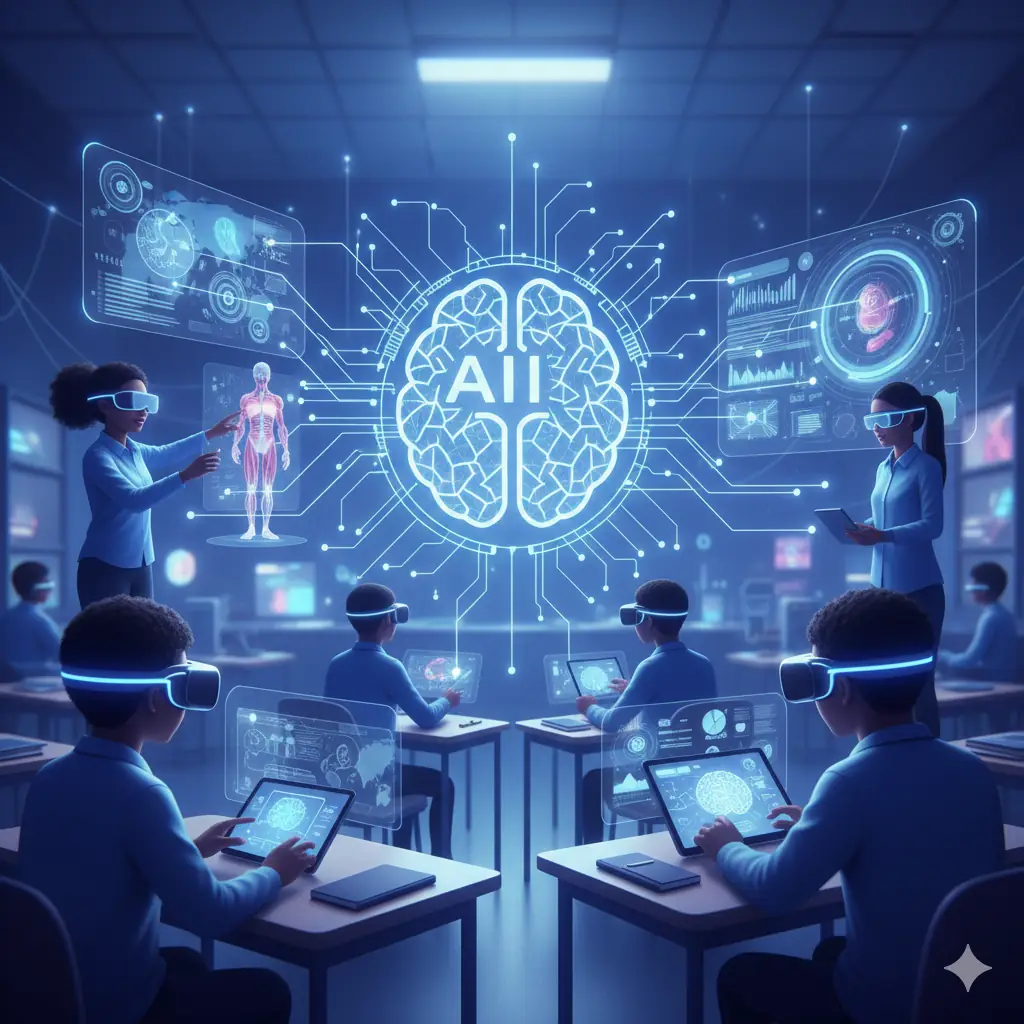
imagining Tomorrow’s Learning Spaces
For decades, the image of a classroom has largely remained consistent: desks, a blackboard, and a teacher at the front. But what if we imagined a learning environment where every tool, every interaction, and every resource was seamlessly digital?
The vision of a fully digital classroom isn’t about replacing teachers with robots, but about empowering educators and learners with tools that unlock unprecedented levels of personalization, engagement, and access.
It’s a classroom without geographical boundaries, where learning is adaptive, immersive, and driven by insights, not just intuition. This future is rapidly becoming a reality.
Let’s explore the key components that define this exciting vision for education.
🧠 Personalized Learning Powered by AI
In a fully digital classroom, Artificial Intelligence (AI) will be the engine for personalized learning. Gone are the days of one-size-fits-all instruction; AI systems will understand each student’s unique learning style, pace, and knowledge gaps.
AI tutors could provide instant, tailored feedback on assignments, guide students through challenging concepts with customized explanations, and recommend resources perfectly suited to their needs.
For example, if a student struggles with algebraic equations, the AI might present a different set of interactive problems and a video tutorial explaining the concept in a new way, all in real-time.
This ensures that every student receives the exact support they need, when they need it, maximizing their potential and minimizing frustration.
Immersive Experiences with VR and AR
The fully digital classroom will move beyond flat screens into truly immersive learning experiences powered by Virtual Reality (VR) and Augmented Reality (AR). Textbooks will come to life in 3D.
Imagine dissecting a frog in a virtual lab without any mess, exploring ancient Roman ruins through a VR headset, or seeing augmented reality overlays of the human circulatory system on a classmate.
These technologies allow students to experience abstract concepts in a tangible, interactive way, fostering deeper understanding and retention. They make learning memorable and engaging.
This is where learning becomes not just theoretical but experiential, transforming passive consumption into active exploration.
🤝 Global Collaboration and Connected Classrooms
Digital classrooms inherently break down physical walls, enabling unprecedented global collaboration. Students will routinely work on projects with peers from across the world, gaining invaluable cultural insights.
Cloud-based collaborative tools will allow real-time co-creation of documents, presentations, and even scientific experiments. Video conferencing will be crystal clear, eliminating geographical barriers.
For instance, a class studying global warming could collaborate with students in another country to collect local environmental data, sharing and analyzing findings together.
This fosters not just academic understanding but also vital cross-cultural communication and teamwork skills, preparing students for a globally connected future.
⭐ Key Insight: The fully digital classroom shifts the focus from ‘teaching to the middle’ to personalized, student-centric learning, addressing individual needs at scale.
📊 Data-Driven Insights for Educators
In a fully digital environment, every interaction, every assignment, and every learning pathway generates valuable data. This data provides rich insights for educators to refine their teaching strategies.
Dashboards can show teachers which concepts their class struggled with most, identify students who need intervention, and highlight successful teaching methods. This moves beyond guesswork to informed decision-making.
For example, a teacher could analyze data from a digital quiz to instantly see that 70% of the class misunderstood a specific historical event and then adjust the next lesson to re-teach that concept.
This data-driven approach allows for continuous improvement in instruction, making teaching more responsive and effective.
Dynamic, Accessible Resources
The fully digital classroom means all learning resources are dynamic, up-to-date, and universally accessible. Textbooks become interactive e-books with embedded multimedia, links, and real-time updates.
Digital libraries provide instant access to vast collections of academic journals, videos, and simulations. Accessibility features, like text-to-speech, translation, and adjustable font sizes, are built-in for all learners.
This ensures that every student, regardless of their individual needs or geographical location, has equitable access to the highest quality and most current learning materials.
It creates a flexible, inclusive learning ecosystem that constantly evolves with new information.
🌟 The Future is Bright and Connected
The vision of a fully digital classroom is one where technology serves as a powerful enhancer, not a replacement, for human interaction and the joy of discovery. It’s about leveraging tools to make learning more effective, engaging, and equitable.
As we continue to integrate AI, VR, global connectivity, and data analytics, the classroom of tomorrow will be a dynamic, personalized, and boundary-less space where every student can thrive.
It’s an exciting future where learning is truly tailored to the individual, preparing them for a world that demands adaptability, critical thinking, and a lifelong love for knowledge.
