

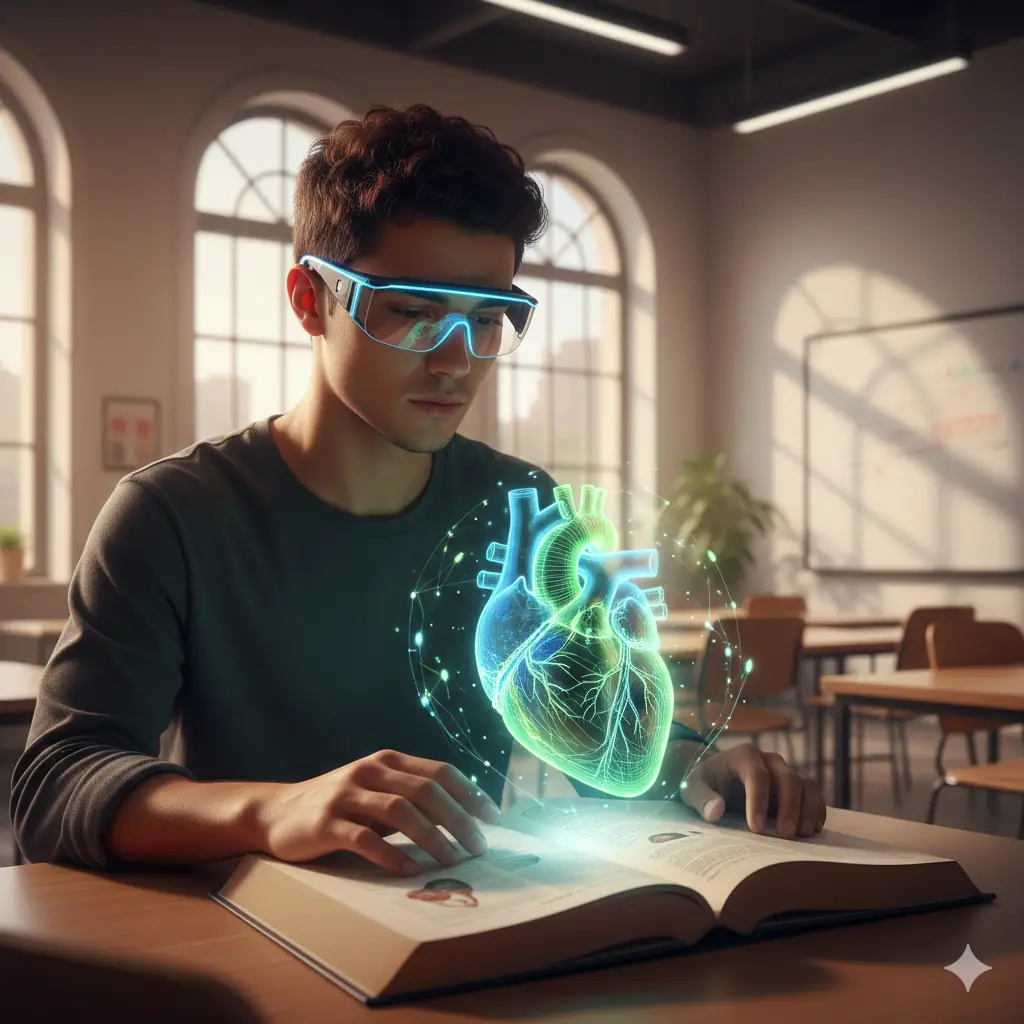
In the quiet revolution sweeping through education and professional training, one technology stands out for its unique power to bridge the gap between theory and practice: Augmented Reality (AR).
Unlike its fully immersive cousin, Virtual Reality, AR keeps us firmly rooted in the real world while seamlessly layering digital information, much like having an expert tutor whispering insights directly into your ear.
This subtle, yet profound, capability is fundamentally redefining what “hands-on learning” truly means, transforming mundane tasks into deep, guided experiences.
Let’s explore how this invisible lab coat is becoming the essential tool for intermediate learners across every discipline.
The Cognitive Leap: Understanding AR’s Unique Value
At its core, hands-on learning thrives on two elements: physical interaction and immediate feedback. Traditionally, this meant expensive equipment, safety risks, or the sheer logistical challenge of being in the right place at the right time.
AR elegantly solves these bottlenecks by delivering complex, context-aware instructions and visualizations exactly where they are needed—over the object being studied.
Imagine trying to learn complex wiring. A textbook diagram is abstract; a physical device is opaque. AR overlays the correct circuit path directly onto the machine, highlighting where to connect the red wire *now*.
This instant, visual guidance reduces cognitive load, allowing the learner to focus on the *why* of the task rather than struggling with the *how* of the instructions.
From Theory to Practice: AR in Technical Fields
Technical and vocational training environments have been the most immediate beneficiaries of AR’s hands-on power. The stakes here are often high, involving machinery, dangerous chemicals, or delicate procedures.
Take the automotive industry, for example. Instead of dismantling a valuable engine block multiple times, a trainee can use AR to see the oil pump’s internal workings animated *inside* the physical engine.
This visualization allows for safe, repeatable practice without the fear of costly mistakes or resource depletion, acting as a perfect, infinitely patient guide.
For medical students, the process is equally transformative. Dissecting a cadaver is a one-time, non-reversible learning opportunity. AR allows students to project anatomical labels, muscle actions, and physiological data onto plastic models or even a patient dummy.
This allows for repeated surgical rehearsal and diagnostic training that would be impossible or unethical in a real-world setting, significantly boosting confidence before the first clinical rotation.
A recent pilot study with aircraft maintenance technicians showed that those using AR-guided repair protocols achieved a 30% reduction in error rates and completed tasks 15% faster than their peers using traditional paper manuals. The digital overlay of schematics and tool requirements eliminated hunting for information.
The Roadmap of AR-Enhanced Learning
Adopting AR isn’t just about wearing cool glasses; it’s a strategic shift in how we structure educational experiences. The journey often follows a predictable, highly effective structure designed to maximize information retention and skill transfer.
- Digital Overlay & Identification: The learner targets a real-world object (a circuit board, a human bone, a piece of industrial machinery). AR instantly overlays digital information, such as component names or structural details.
- Step-by-Step Guided Action: For procedural tasks, the AR system projects arrows, highlights, and text prompts, guiding the learner through each required action in real-time. This is often called “just-in-time” learning.
- Immediate Haptic/Visual Feedback: If the learner places a component incorrectly, the AR system flashes red and issues an auditory warning. If correct, it flashes green, instantly reinforcing the positive action.
- Performance Capture and Review: The entire learning session is recorded. Post-session, the learner can review a spatial and temporal playback of their actions, pinpointing areas where they hesitated or made errors.
- Contextual Scaffolding Removal: As proficiency increases, the system automatically removes certain AR prompts, forcing the learner to rely more on their internalized knowledge, thereby moving them toward true mastery.
This structured approach ensures that the digital scaffolding is only temporary, designed to be removed once the learner is ready to stand on their own expertise.
Beyond Technical Skills: AR in Abstract Concepts
While the utility of AR in technical training is evident, its power to make abstract concepts tangible is perhaps its most exciting pedagogical contribution. It makes the invisible visible.
Think about a subject like chemistry. Understanding molecular bonds or crystal lattices is notoriously difficult, relying heavily on static 2D diagrams. With AR, a student can view a three-dimensional methane molecule hovering over a lab bench.
They can walk around it, change its temperature to see bond vibration, or even virtually manipulate the atoms—something impossible with physical models or flat screens.
Making Data Truly Immediate
For data science and physics, AR allows learners to escape the confines of a spreadsheet or a graph. Imagine studying aerodynamics: a student can hold a phone up to a physical wing model and see the airflow dynamics, pressure gradients, and lift vectors animated directly onto the model.
The data is no longer an abstract chart; it becomes an immediate, physical property of the object they are observing, deepening the intuitive connection to the underlying physics.
This is where AR shifts from being a mere teaching tool to becoming a cognitive amplifier, changing how we perceive complex, dynamic systems.
Weighing the Practicalities: AR’s Place in the Classroom
Despite the immense advantages, a responsible look at AR’s implementation requires acknowledging the practical challenges. It’s not a silver bullet, but a powerful addition to the existing educational arsenal.
| ✅ Pros of AR in Hands-On Learning | ❌ Cons of AR Implementation |
|---|---|
| Reduces errors and risk in complex, high-stakes tasks. | Initial cost of AR hardware (headsets, powerful tablets) can be high. |
| Allows for infinite, non-destructive practice and simulation. | Requires a significant investment in creating high-quality, education-specific digital content. |
| Makes abstract concepts (like molecules or data) three-dimensional and interactive. | Potential for ‘gimmick’ use if content is not pedagogically sound or well-integrated. |
| Provides just-in-time, context-aware guidance, improving flow state. | Concerns about screen time, digital fatigue, and reliance on the tech over innate skill. |
The core challenge is not the technology itself, but the creation of high-quality, academically rigorous content that truly leverages AR’s spatial advantages rather than simply duplicating a textbook.
The goal is always to improve human capability, not replace it; the technology must serve the pedagogy, not the other way around.
The Future is Layered: A Mature Perspective
Augmented Reality is not designed to eliminate the physical workshop, the lab bench, or the mentor. Instead, it serves to make these real-world learning environments dramatically more effective and accessible.
By providing an adaptive digital layer, AR ensures that every hands-on interaction—whether with a delicate biological specimen or a robust machine—is guided, informed, and immediately productive.
As the hardware becomes cheaper and the content creation tools simplify, AR will transition from an innovative novelty to a standard piece of educational infrastructure, much like the whiteboard or the projector.
It’s an empowering future where learning is no longer a passive reception of facts, but an active, guided discovery within the bounds of our immediate physical reality.
The invisible lab coat is here to stay, and it’s making us all smarter, safer, and infinitely more capable.
