

💡 The Journey Begins: Early Digital Footprints
It’s fascinating to look back and trace how technology first seeped into the classroom. For many of us who grew up in the 80s and 90s, the “digital classroom” often meant a single computer, perhaps an Apple II or a Commodore, rolled in on a cart.
These early attempts were less about integration and more about exposure, treating the computer lab as a special, separate place. Yet, these moments were crucial, representing the first collective acceptance that digital tools had a place in the educational landscape.
The software was simple, often drill-and-practice applications, but it planted a seed. Educators began to see the potential for individualized feedback and instruction, even if the delivery was clunky by today’s standards.
Think of programs that taught basic typing skills or simple math facts—it was a foundation built on basic interaction, a far cry from the immersive environments we enjoy now.
💻 The Internet Arrives: Connecting the Classroom
The real shift began with the widespread adoption of the internet. Suddenly, the isolated computer in the corner became a gateway to a universe of information, fundamentally changing the research process.
Gone were the days where an essay required flipping through the Dewey Decimal system and sifting through microfiche. Instead, a wealth of primary and secondary sources was just a click away.
This phase introduced the concept of the classroom being a connected node, rather than an isolated room. Email became a standard way for students to submit work and for parents to communicate with teachers.
The focus shifted from consuming pre-packaged software to actively curating and interacting with live, dynamic content, which brought new challenges around source evaluation and digital citizenship.
The Rise of Learning Management Systems (LMS)
As digital content expanded, the need for organization grew, leading to the development of Learning Management Systems like Moodle or Blackboard. These platforms became the digital backbone of the classroom.
An LMS centralized everything: grade books, lesson plans, assignments, and discussion forums, making the educational process far more transparent and streamlined for everyone involved.
For example, a student could access a recorded lecture from home, take a quiz, and check their overall progress all within one interface. This was a critical step toward blending physical and virtual learning spaces.
The ability to track individual student engagement and performance digitally provided educators with data they never had before, enabling more informed interventions.
📱 Mobile and Cloud: Ubiquitous Digital Access
The true revolution in accessibility arrived with mobile devices and cloud computing. The shift from desktop towers to sleek laptops and powerful tablets meant learning could literally happen anywhere, anytime.
Cloud-based tools, like Google Workspace or Microsoft 365, introduced real-time collaboration that mirrored the professional world. Students could now co-author a paper simultaneously from different locations.
This mobility democratized access to learning resources, moving instruction off the school server and onto a student’s personal device. This gave rise to the “flipped classroom” model.
The flipped model, where students watch lectures as homework and use class time for guided practice and discussion, perfectly leveraged the power of personalized access.
🔥 Quick Insight: The transition to cloud-based tools moved the educational focus from simply delivering content to facilitating complex, collaborative knowledge creation.
🧠 Personalized Learning and AI: The Current Frontier
Today, the focus has moved squarely onto personalization, driven largely by advancements in Artificial Intelligence (AI) and machine learning. Digital tools are no longer one-size-fits-all.
Adaptive learning platforms are now capable of adjusting the difficulty, pace, and content presentation based on a student’s real-time performance and learning style.
Consider an adaptive math platform: if a student struggles with fractions, the system provides extra practice and different instructional videos until mastery is achieved, while a student who excels moves on to algebra.
This level of tailoring is something a single teacher in a busy classroom simply couldn’t manage manually, proving that technology can augment, rather than replace, great teaching.
Immersive Technology: VR and AR
Beyond traditional screen-based learning, immersive technologies are pushing the boundaries of what is possible in education. Virtual Reality (VR) and Augmented Reality (AR) offer experiences that transcend the textbook.
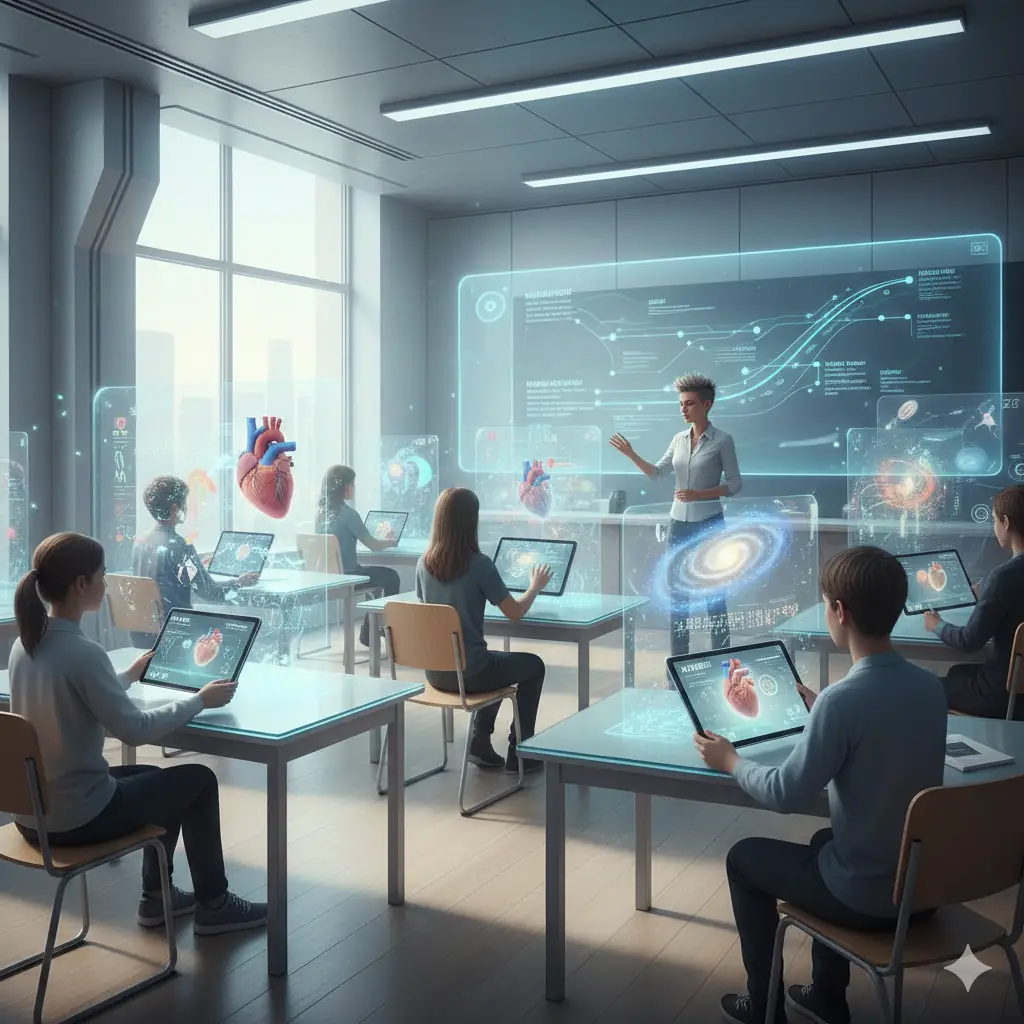
Imagine a history class where students can virtually walk the streets of ancient Rome, or a biology class where they can dismantle a virtual human heart in 3D. The engagement and retention from these experiences are unparalleled.
While still emerging, these tools provide a powerful avenue for complex concepts that benefit from spatial understanding, making abstract ideas tangible and exciting.
🔭 Looking Ahead: The Future Classroom
The trajectory of digital learning suggests a future where the line between physical and digital instruction is almost invisible. Educational technology will become utterly seamless and intuitive.
We are likely to see even deeper integration of AI tutors that provide instant, high-quality feedback on complex projects, much like a personal mentor.
Furthermore, the data generated by these advanced systems will help educators identify learning gaps and exceptional talents with unprecedented precision, ensuring every student gets exactly what they need to thrive.
The core goal, however, remains unchanged: to empower learners. The tools have simply become exponentially more powerful in achieving that timeless objective.
