

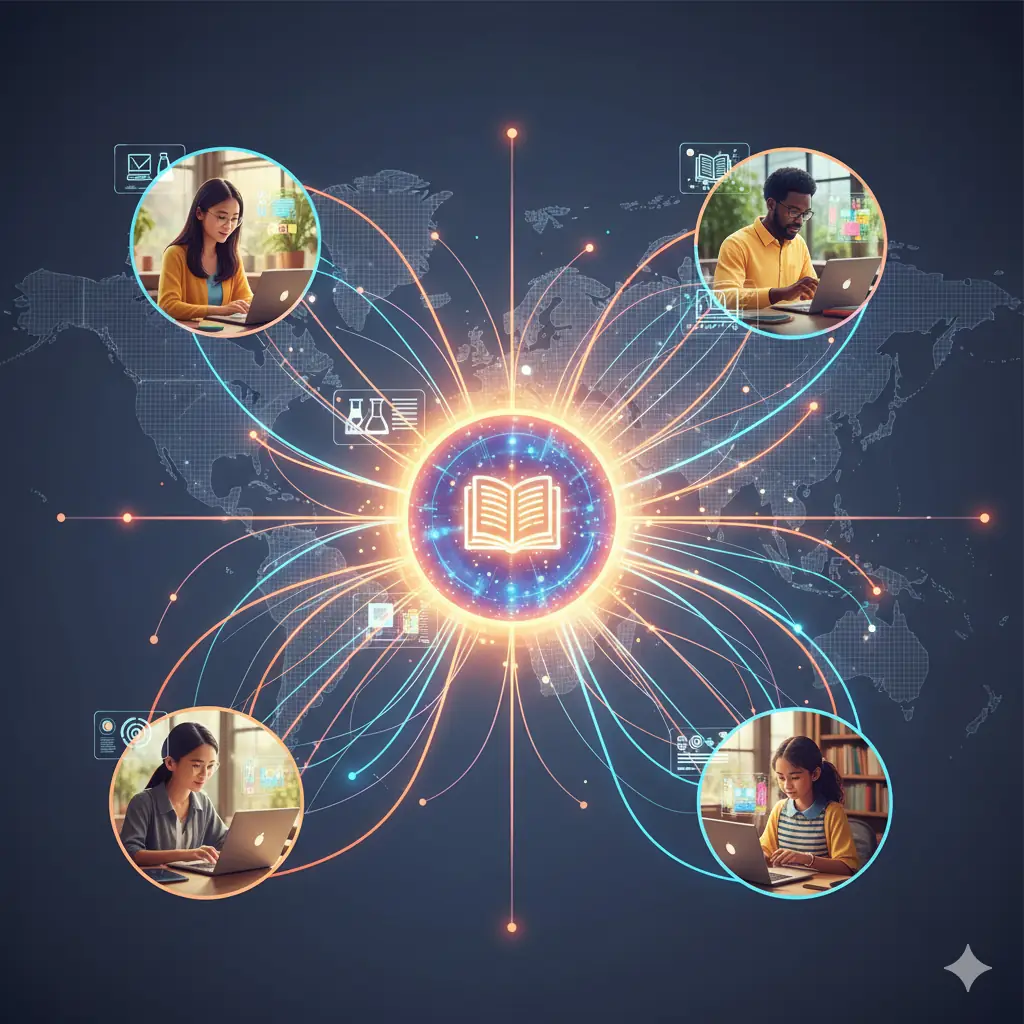
🌍 Breaking Down Walls: Accessibility for All
Remember a time when learning was largely confined to physical classrooms and set schedules? Those days are rapidly becoming a memory, thanks to the rise of online learning platforms.
These platforms have fundamentally reshaped education by making it accessible to virtually anyone, anywhere, with an internet connection. Geography, physical limitations, or even economic constraints are no longer insurmountable barriers.
Think about a student in a remote village accessing a university lecture from a top institution, or a working professional upskilling in a new field without leaving their job. This was unimaginable just a few decades ago.
This unprecedented reach democratizes knowledge, opening up opportunities for millions who might otherwise be excluded from traditional educational pathways.
⏰ Learning on Your Own Schedule: The Power of Flexibility
One of the most profound changes online learning platforms bring is unparalleled flexibility. They cater to diverse lifestyles, allowing learning to fit around life, rather than forcing life to fit around learning.
Whether you’re a parent juggling childcare, an employee working full-time, or someone with unique learning needs, online platforms offer courses that can be taken at your own pace and time.
Many courses are asynchronous, meaning you don’t have to be online at a specific hour for a lecture. You can watch recorded videos, read materials, and complete assignments whenever suits you best.
This flexibility is not just about convenience; it often leads to better learning outcomes as students can engage with material when they are most alert and able to concentrate.
🎯 Personalized Pathways: Education Tailored to You
Online platforms are moving beyond a one-size-fits-all approach, increasingly offering personalized learning experiences. This means content and pace can adapt to individual student needs.
Using algorithms and AI, some platforms can identify areas where a student is struggling and provide additional resources or different explanations, much like a personal tutor would.
For example, a math platform might offer extra practice problems on fractions if a student consistently makes errors, while another student who excels can move on to more advanced topics.
This level of customization ensures that learners are challenged appropriately and receive support precisely where they need it, optimizing both engagement and mastery.
📚 Beyond Textbooks: Rich and Diverse Content
Traditional education often relies heavily on textbooks and lectures. Online platforms, however, can integrate a vast array of multimedia content, making learning more dynamic and engaging.
From interactive simulations and virtual labs to high-quality video lectures and gamified exercises, the possibilities for content delivery are expansive and exciting.
Imagine learning about astronomy through an interactive 3D model of the solar system, or practicing surgical procedures in a virtual reality environment. These experiences are far more immersive than static text.
This diversity of content caters to different learning styles, helping to make complex topics more understandable and memorable for a wider range of students.
🤝 Fostering Global Collaboration and Community
While often perceived as solitary, online learning platforms are actually powerful tools for fostering global collaboration and building vibrant learning communities.
Discussion forums, group projects, and peer review systems allow students from different countries and backgrounds to interact, share perspectives, and learn from one another.
This exposure to diverse viewpoints enriches the learning experience and develops crucial 21st-century skills like cross-cultural communication and digital collaboration.
It transforms the classroom from a local space into a global one, preparing students for an interconnected world where remote teamwork is increasingly common.
| Feature | Traditional Education | Online Learning Platforms |
|---|---|---|
| Access | Location-bound, limited capacity | Global, scalable, 24/7 |
| Pace | Fixed, instructor-led | Flexible, self-paced, adaptive |
| Content | Textbooks, lectures | Multimedia, interactive, AI-driven |
| Interaction | In-person only | Global forums, virtual groups, direct feedback |
🔮 The Future Is Hybrid: Blending the Best of Both Worlds
The impact of online learning platforms isn’t about replacing traditional education entirely, but about creating a more dynamic, hybrid future for learning. It’s about blending the best of both worlds.
Many institutions are adopting blended learning models, where some content is delivered online, freeing up in-person class time for deeper discussions, hands-on projects, and individualized mentorship.
This approach leverages the strengths of both environments: the efficiency and personalization of digital tools with the invaluable human connection and social learning of physical classrooms.
Ultimately, online learning platforms are not just a temporary trend; they are a permanent, positive force changing how we learn, teach, and grow in the modern world.
